Walk into any big-box home improvement store and you’ll find rows of kitchen cabinets ready to go home with you that same day. They’re affordable, they look fine in the showroom and the price tag is hard to argue with. So why do so many homeowners end up regretting them two years later?
The honest answer is that stock cabinets and custom cabinets aren’t really competing for the same job. One is built to fit a standard kitchen. The other is built to fit yours. Whether that difference matters — and how much it’s worth — depends on what you’re actually working with.
We’ve done both. We’ve installed stock cabinets in straightforward layouts where they worked perfectly and built full custom kitchens from scratch where nothing else would have. Here’s what we’ve learned — and what you need to know before making a decision that affects how your kitchen looks and functions for the next 20 years.
What “Stock” Actually Means — and Where It Falls Short
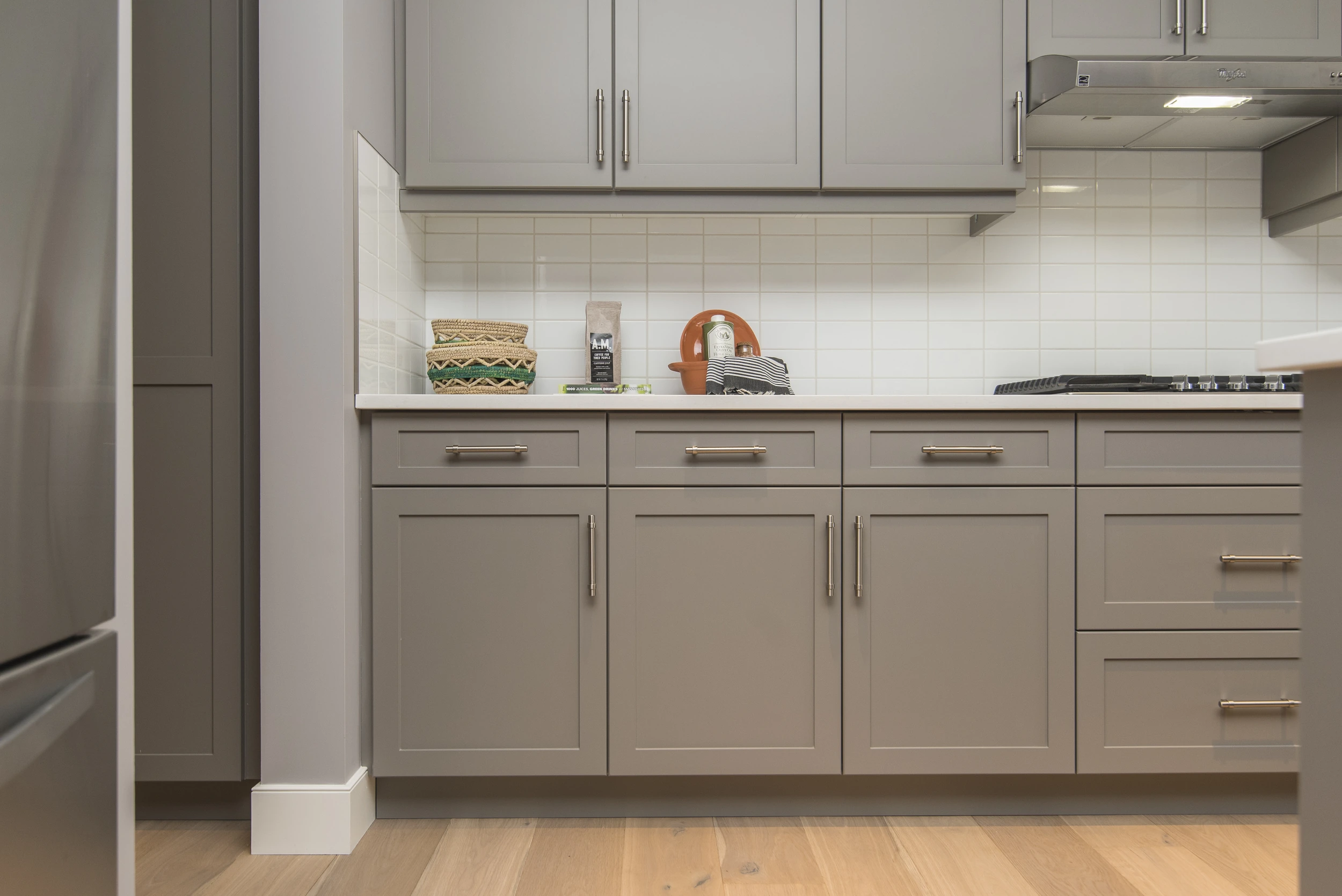
Stock cabinets are manufactured in fixed sizes, typically in 3-inch increments, and stored in warehouses until sold. You pick from what’s available. Finish options are limited, box depths are standardized and the interior fittings — shelves, drawer slides, hinges — are whatever the manufacturer chose.
That’s fine if your kitchen happens to be built around those standard dimensions. Most aren’t. The gap problem is real. When stock cabinets don’t fill a run of wall exactly, you’re left with filler strips — narrow pieces of wood or trim used to cover the space between the cabinet and the wall. Done well, fillers are barely noticeable. Done poorly, they’re the first thing you see every time you walk into the room. And in older Ontario homes, where walls aren’t always straight and corners aren’t always square, getting stock cabinets to look right takes more work than most homeowners expect going in. We’ve seen kitchens where the filler work alone added half a day to the job.
What Stock Cabinets Do Well
- Fast lead times — often available same day or within a week
- Lower upfront cost, typically $150–$400 per linear foot installed
- Predictable sizing makes planning straightforward for simple layouts
- Wide availability through local suppliers and big-box retailers
The trade-off is this: you’re designing your kitchen around the cabinet, not the other way around.
What Custom Cabinets Actually Get You
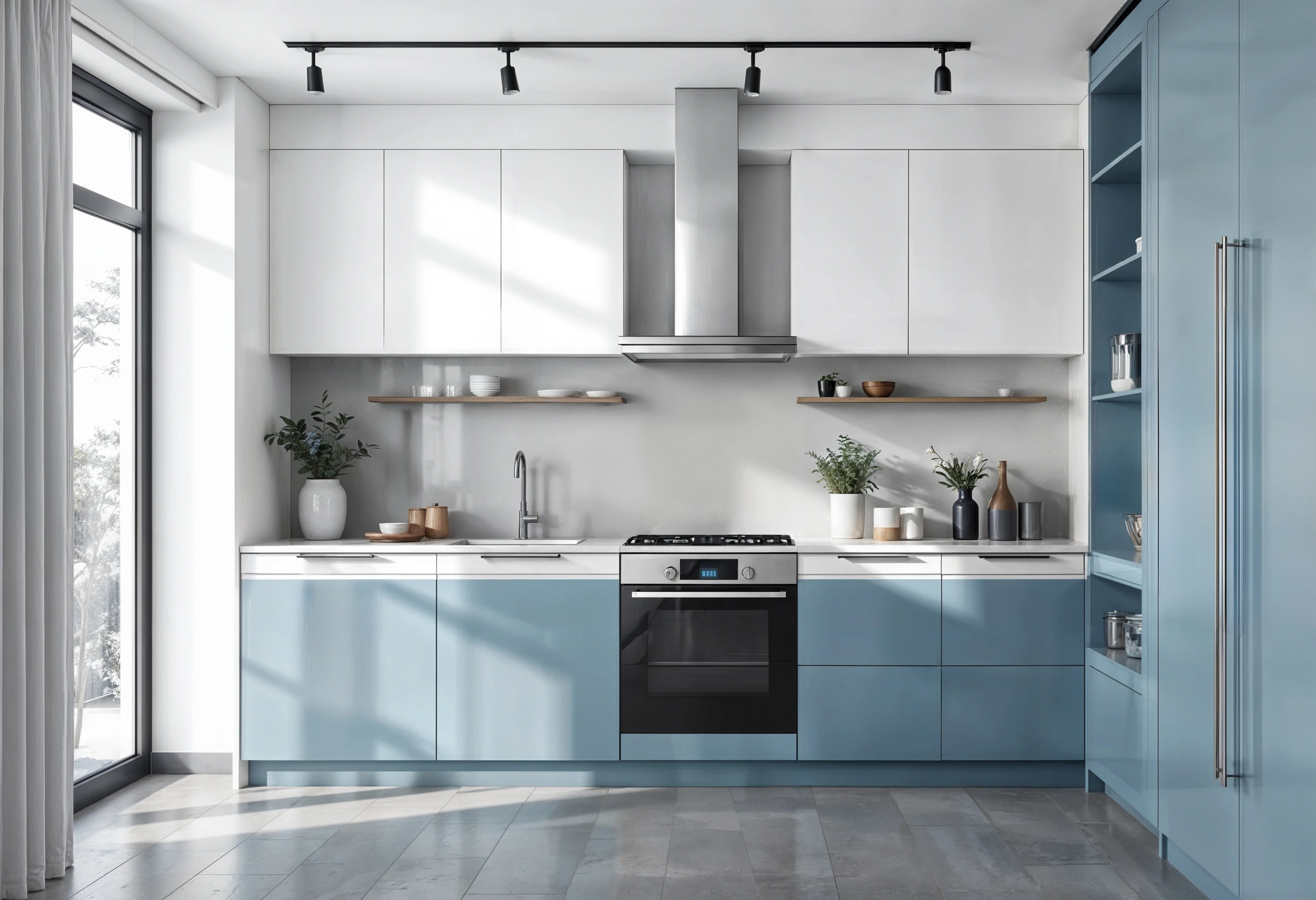
Custom cabinets are built to your exact specifications — the dimensions of your kitchen, your storage needs, your preferred materials and the finish you want. Nothing is pulled from inventory. Everything is made for the space.
That sounds like a luxury. In some kitchens, it is. In others, it’s the only option that actually works.
Take a kitchen with a soffit, an angled ceiling or an awkward corner. Stock cabinets in those situations leave gaps, require workarounds or simply don’t fit. Custom cabinetry solves those problems at the build stage — there’s no patching required after the fact. The cabinets are designed around the obstacle, not despite it. We’ve built around load-bearing posts, old chimneys and ceilings that drop two inches across a single cabinet run. Every one of those kitchens came out clean because the solution was designed in, not improvised on site.
There’s also the functional side. Custom cabinets can be built with pull-out shelves, deep drawer banks, integrated spice racks, hidden waste bins and whatever else actually matches how you use your kitchen. Stock cabinets offer some of these as add-ons, but they’re often retrofitted into boxes that weren’t designed for them.
Where Custom Cabinets Make The Biggest Difference
- Kitchens with unusual dimensions, soffits or non-standard ceiling heights
- Layouts where maximizing storage in every inch matters
- Homeowners who want a specific wood species, stain or painted finish
- Anyone planning to stay in the home long-term and wants it done once, done right
Custom cabinet pricing in Ontario typically starts around $500–$800 per linear foot installed, depending on material and complexity. That’s a real cost difference from stock — but it’s the right comparison only if you’re comparing the same outcome.
The Semi-Custom Middle Ground
There’s a third option that often gets overlooked: semi-custom cabinets. These are factory-built like stock but offer more size flexibility — usually in 1.5-inch increments — and a wider range of finishes, door styles and interior configurations.
Semi-custom sits in a useful middle range. You get more flexibility than stock without the full cost of custom. For kitchens that are close to standard but not quite, semi-custom often solves the fit problem without requiring a full custom build. Pricing typically falls between $300 and $600 per linear foot installed — a meaningful step up from stock but still well below full custom territory.
The downside is lead time. Semi-custom cabinets are ordered, not pulled from a shelf — expect 4 to 8 weeks depending on the supplier. If you’re working to a tight renovation schedule, that’s a variable worth planning around. It also means the design decisions need to be locked in earlier. Changes after the order is placed usually aren’t possible, and if something arrives damaged, the replacement timeline can push your project back significantly.
That said, for many kitchens in the Trent Hills area — homes built in the 1970s through the 1990s with layouts that are mostly standard but not perfectly square — semi-custom is often the most practical choice. It’s what we recommend more often than people expect. You get a better fit than stock and better lead times than full custom, without paying for a level of precision your kitchen may not actually need.
How to Actually Decide
The cabinet decision isn’t just about budget. It’s about your kitchen, your timeline and how long you’re staying in the home. When homeowners call us for a kitchen quote, these are the questions we ask before we talk about anything else.
- Is your kitchen a standard layout? If yes, stock or semi-custom may work fine. If the layout is unusual, custom is worth pricing out before assuming it’s out of reach.
- How long are you staying? If you’re renovating to sell in the next two to three years, stock cabinets with quality hardware and a good paint finish can look sharp without the custom price tag. If you’re staying for 15 years, the calculus shifts.
- What’s driving the renovation? Storage problems, worn-out boxes and an outdated layout are all arguments for custom. Cosmetic updates — new doors, new hardware, a fresh coat of paint — sometimes solve the problem without replacing cabinets at all.
- What’s the rest of the kitchen doing? High-end countertops and appliances paired with stock cabinets can look mismatched. Custom cabinetry ties a kitchen together in a way that stock rarely does at a comparable level.
There’s no universal right answer here. A well-chosen stock cabinet in a well-designed kitchen beats a poorly planned custom one every time.
Why Craftsmanship Still Matters — Regardless of Which You Choose
The quality of the installation matters as much as the quality of the cabinet. Stock cabinets installed poorly look worse than good stock cabinets installed well. Custom cabinets installed by someone who doesn’t know how to read a level aren’t worth what you paid for them.
This is where experience in finish carpentry makes a real difference — and it’s where we spend most of our time on a kitchen job. Getting cabinets to sit level, plumb and flush — especially in older homes where walls drift and floors aren’t flat — requires skill, patience and the right tools. Scribing a cabinet to a textured wall, fitting a corner unit without visible gaps, getting every door to hang consistently: these are the details that separate a kitchen that looks finished from one that looks almost finished. We’ve walked into kitchens where the cabinets cost $30,000 and the install looked like it was done on a Friday afternoon. The cabinets weren’t the problem.
Think of it like fitting a suit. You can buy an expensive suit off the rack and still look sloppy if it doesn’t fit your shoulders. The fabric matters — but the fit is what people actually see. Cabinets work the same way.
A few installation details that are easy to get wrong:
- Shimming and levelling — floors in older homes are rarely flat over a full cabinet run; this needs to be corrected at installation, not patched with trim afterward
- Scribing to walls — where a cabinet meets a wall or ceiling, the gap needs to be scribed tight, not filled with caulk
- Crown moulding alignment — running crown along the top of upper cabinets looks simple and is one of the most unforgiving details to get right
- Door adjustment — every door needs to be individually adjusted after installation; a kitchen with misaligned doors looks sloppy no matter how good the cabinets are
At Renossance, cabinetry is where we started. Our background in custom cabinetry and finish carpentry is what shaped the way we approach every kitchen renovation — attention to detail from the framing construction right through to the final hardware installation.
What Renossance Does
We handle kitchen renovations and custom cabinet installations across Trent Hills and the surrounding area — Campbellford, Hastings, Havelock, Marmora, Norwood, Warkworth and Stirling. Whether you’re going custom, semi-custom or working with stock cabinets that need a precise fit, we do the work properly from the start.
We’re a general contractor service, insured and bonded, with 7+ years of hands-on experience in kitchen renovations and custom cabinetry. No shortcuts on the install.
If you’re planning a kitchen renovation and want an honest conversation about what option makes sense for your space, give us a call.

