Most homeowners think about eavestroughs twice a year — when they’re clogged with leaves in October, and when water is pouring over the edge during a June rainstorm. Spring rarely makes the list. That’s a mistake. The period between snowmelt and the first heavy rain is exactly when eavestroughs need attention — and when problems from winter are easiest to catch before they turn into something worse.
This post covers what to look for, what spring actually does to eavestroughs in Trent Hills, and when cleaning becomes a repair conversation. If you’ve been putting it off, now is the right time.
What Winter Does to Eavestroughs in This Area
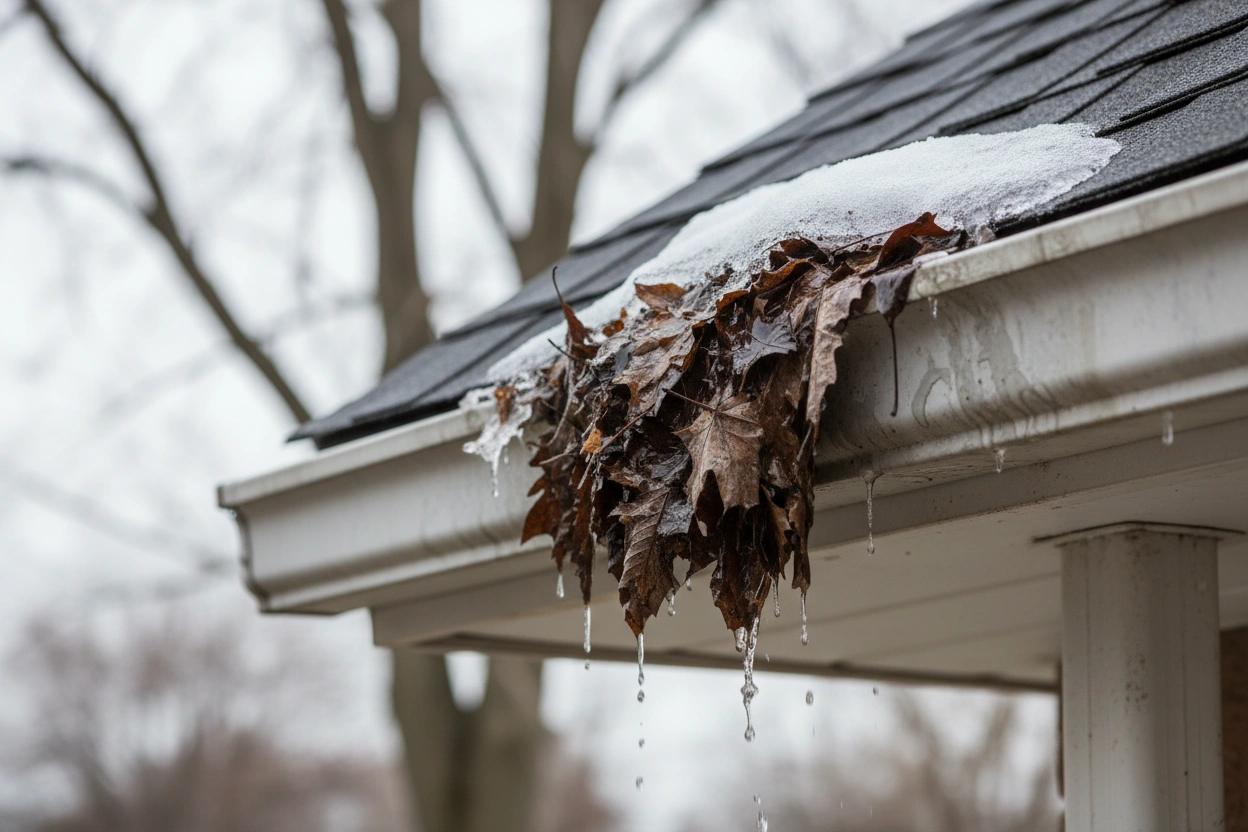
Trent Hills winters are hard on gutters in ways that aren’t always obvious from the ground. Ice dams are the most visible culprit — when ice builds up at the roofline, the weight and expansion can pull eavestrough sections away from the fascia, warp the profile and crack seams at the joints. But that’s just the dramatic end of the damage spectrum.
More commonly, the freeze-thaw cycle works at the fasteners. Spikes and hangers that were holding fine in November get pushed and pulled through dozens of temperature cycles between December and March. By spring, some of them have shifted — enough that the slope of the trough has changed. Water that should run toward the downspout now pools in a low spot instead. That standing water adds weight, attracts mosquitoes and accelerates corrosion. None of it is visible until you get up and look.
Debris is the other factor. Leaves, seed pods and twigs that settled into the gutters in fall get packed down and compressed by snow over winter. What was loose debris in October becomes a dense, damp mat by April — and unlike loose leaves, it doesn’t flush out with a hose. It has to be removed by hand.
Why Spring Cleaning Beats Fall Cleaning
Fall eavestrough cleaning is useful. Spring cleaning is more important. Here’s the practical difference.
Fall cleaning removes leaves before they can block drainage over winter. That matters. But it doesn’t account for what happens between November and April — ice damage, fastener movement, debris from evergreens and birch catkins that drop through winter and early spring. A eavestrough that was clean going into winter is often partially blocked coming out of it.
More importantly, spring is when you can see the results of winter damage clearly. Joint separations, fascia rot behind the bracket, downspout connections that shifted — all of it is visible once the snow is gone and before summer growth covers the roofline. If there’s a problem, spring is when you have the best window to fix it before the rainy season starts.
The Cost Of Skipping It
A blocked or damaged eavestrough doesn’t just cause overflow. It directs water:
- Along the fascia board — accelerating rot behind the gutter
- Down the exterior wall — behind siding and into the wall assembly
- Against the foundation — the leading cause of basement moisture issues in older Trent Hills homes
None of these are cheap problems. The eavestrough cleaning that gets skipped in May often shows up as a foundation repair estimate in September.
Seamless vs. Sectional – What’s Actually on Your House
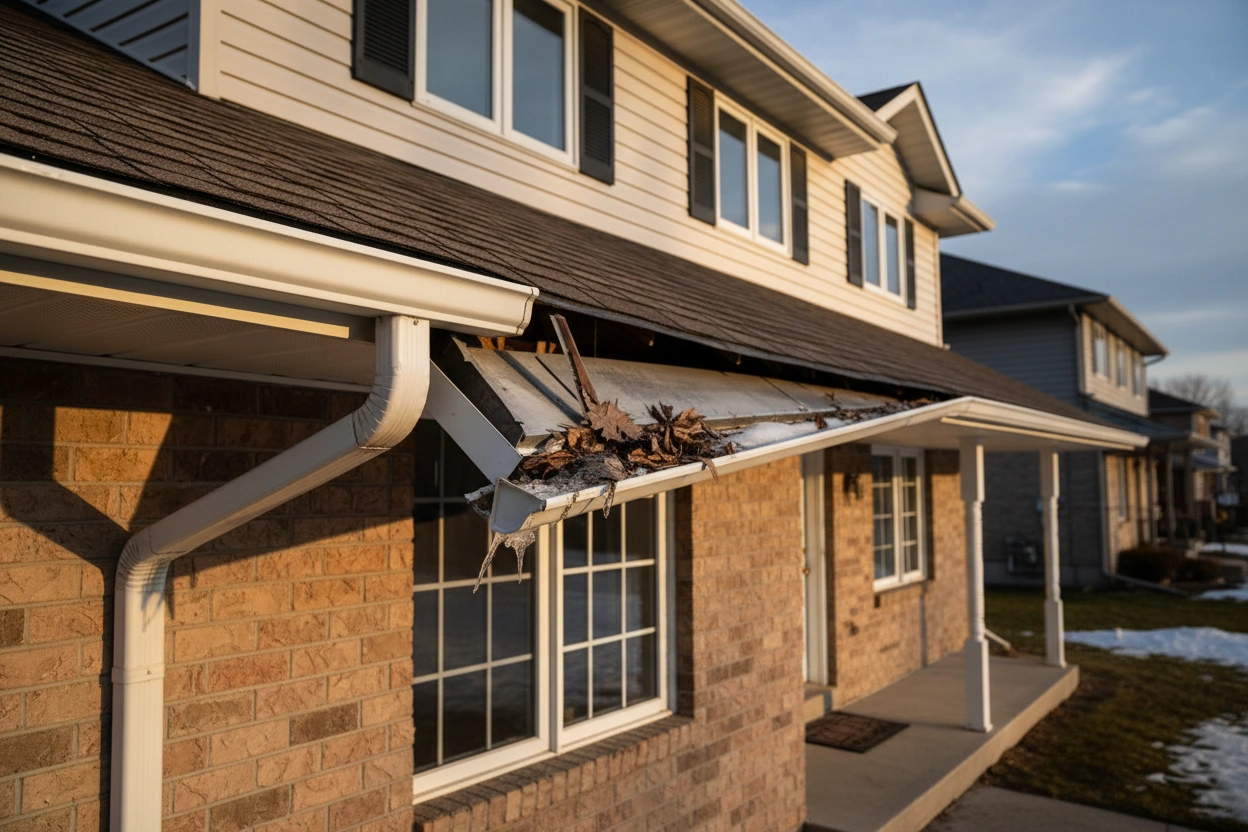
If your home was built or renovated in the last 15–20 years, there’s a reasonable chance you have seamless eavestroughs — extruded on-site from a single continuous run of aluminum, with no joints along the length except at the corners and downspout connections. If it’s an older home, you likely have sectional gutters with visible joints every 10 feet or so.
The difference matters for repairs:
- Sectional eavestroughs have joints every 10 feet — the seams and end caps are the most common failure points, and the usual fix is resealing or replacing individual sections.
- Seamless eavestroughs have joints only at corners and outlet connections. When something fails, it’s typically a fastener or end cap — repaired by refastening or replacing the end cap, not the whole run.
Sectional gutters fail at the seams — that’s where water gets behind the joint, freezes and breaks the seal. Each seam is a potential leak point. Seamless eavestroughs eliminate most of those failure points, which is why they’ve largely replaced sectional systems on new and renovated homes.
If your sectional gutters are leaking at multiple joints and the aluminum is showing its age, cleaning and resealing buys time — but replacement with seamless eavestrough is usually the cleaner long-term answer.
What a Proper Spring Inspection Covers
Cleaning is the obvious part. But a thorough spring inspection goes further than flushing out debris. These are the things worth checking while you’re up there:
- Slope and alignment. Run water through the trough and watch where it goes. It should move steadily toward the downspout. Any pooling points to a low spot caused by a shifted hanger.
- Fascia condition behind the bracket. If the wood behind the eavestrough is soft, dark or showing signs of rot, that needs to be addressed before re-hanging the gutter — otherwise you’re fastening into compromised material.
- Downspout connections and drainage. Downspouts should extend at least 4–6 feet from the foundation and discharge onto ground that slopes away from the house. Extensions that are missing, crushed or terminating against the foundation are a direct path to basement moisture.
- End caps and mitre joints. These are the most common leak points on both seamless and sectional systems. If they’re showing sealant failure, they can usually be resealed — but if the aluminum itself is corroding at the joint, replacement is the better call.

When Cleaning Becomes a Repair Conversation
Most spring eavestrough visits start as cleaning jobs and stay that way. But roughly a third of the time, cleaning reveals something that needs fixing. The most common findings we see across Trent Hills and Campbellford:
- Sections that have pulled away from the fascia by more than a few millimetres
- End caps leaking at the corners — usually from sealant failure after ice expansion
- Downspouts that are partially crushed or disconnected at the elbow
- Fascia boards showing rot behind the hanger bracket
None of these are emergencies on a dry day in May. All of them become emergencies on a rainy day in July. The difference between a repair and a fascia replacement is usually about six weeks of rain.
How We Handle Eavestrough Work at Renossance
We install, repair and replace seamless eavestrough across Trent Hills and the surrounding area. That includes Campbellford, Hastings, Havelock, Marmora, Stirling, Norwood and Warkworth.
Seamless eavestrough is fabricated on-site to the exact length of each run — no mid-span joints, cleaner profile and significantly longer lifespan than sectional systems. For homes with aging sectional gutters that are leaking at multiple seams, replacement with seamless is often the most cost-effective path once you factor in the repeated resealing those systems require.
If you’re not sure what you need — cleaning, repair or replacement — a quick look is usually enough to answer that. We’re a general contractor, insured and bonded, with 7+ years of hands-on experience across exterior and interior work throughout the region.
Call (705) 977-4453 or email [email protected] to book a spring inspection.
If you’re working through a broader list of exterior repairs this spring, see our general home repair page for what else we handle across Trent Hills and the surrounding communities.

